Cryosphere
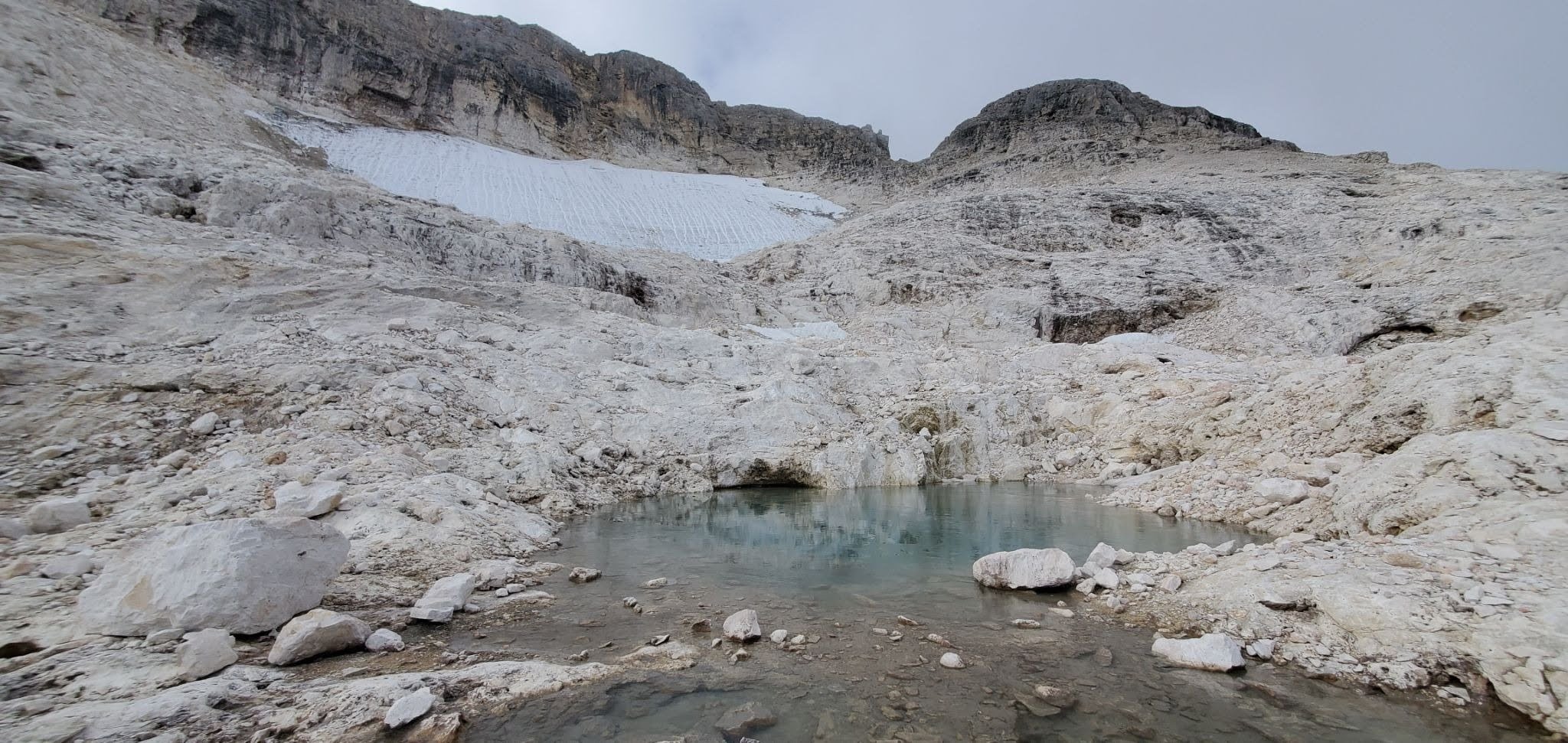
Fradusta glacier (Dolomites, Italian Alps). Photo Credit: M. Gobbi/Archive MUSE.
— CRYOSPHERE —
Cryospheric ecosystems, including ice sheets, glaciers, sea and freshwater ice, permafrost, seasonally frozen ground and snow, cover ~10% of the Earth’s surface and are under threat around the globe due to climate change.
These ecosystems are concentrated towards poles and high elevations, regions warming two or four times faster than the global average. The ongoing climate crisis is rapidly negatively affecting the cryosphere, which is shrinking, shifting, or disappearing altogether. These changes are resulting in the loss of several ecosystem services, such as water availability for local communities and lost habitat for species dependent on them.
More research is needed in the coming years to understand how ice-related landforms provide refugia for cold-adapted species in the face of climate change.
GLACIERS
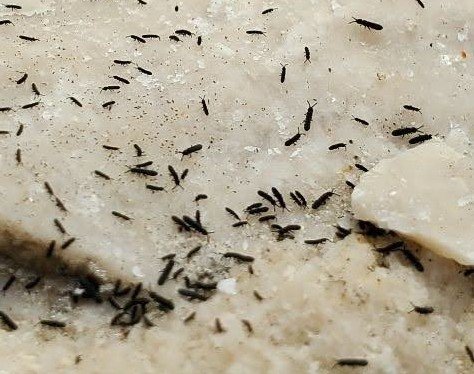
Population of the “glacier flea” Vertagopus fradustaensis (Collembola) found under a stone on the disappearing Fradusta glacier (Dolomites, Italian Alps). Photo Credit: M. Gobbi/Archive MUSE.
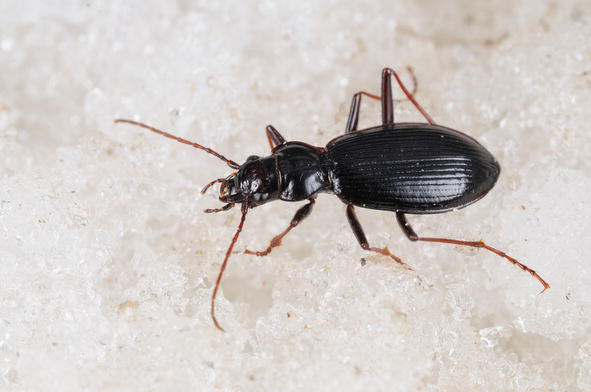
Nebria germarii, a ground beetle that can be typically observed on rock glaciers and debris-covered glaciers of the Central-Eastern Italian Alps; it is a predator that hunts springtails.
Photo credit: F. Pupin/archive MUSE)
Glaciers host exclusive biodiversity
Glacial ecosystems are “biodiversity hotspots”, providing habitat to bacteria, algae, yeasts, fungi, mosses, vascular plants, aquatic and terrestrial invertebrates, and vertebrates. There are several species that live only on glaciers, which can be referred to as cold-adapted or cryophilous (Simoncini et al., 2026); and new species for science are described every year.
One such organism is the “glacier flea” Vertagopus fradustaensis, a springtail arthropod recently described on Fradusta glacier (Dolomites, Italian Alps) (Valle et al., 2025).
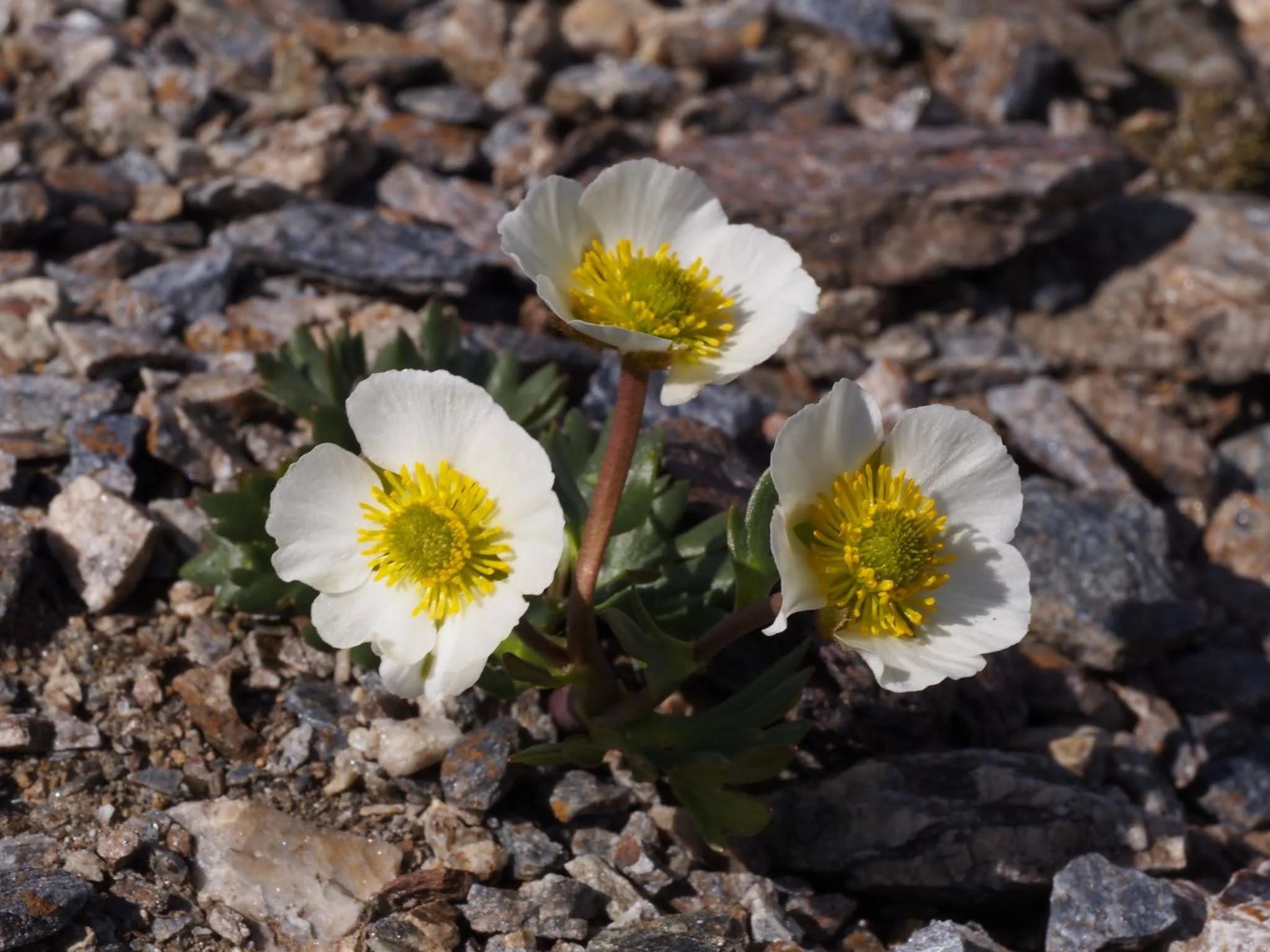
Ranunculus glacialis, a typical high-altitude plant species able to survive on Alpine rock glaciers and debris-covered glaciers. Photo credit: M. Caccianiga
The rate of glacier melt is rapidly increasing, and even more dramatic retreats are forecasted for the next decades with cascading effects on glacier environments. Overall suitable habitat for cold-adapted species will continue to shrink. In response, organisms can either move uphill, adapt, go extinct or find refugia. Some ice-related landforms may provide refugia, sheltering organisms from feeling the full brunt of rising temperatures resulting from climate change.
Rock glaciers and debris covered glaciers act as climate refugia
Rock glaciers and debris-covered glaciers more effectively shield cold-adapted organisms from climate change than debris-free glaciers. Rock glaciers are found in high-altitude and high-latitude environments, consisting of a mix of rock debris held together by interstitial ice. These tongue-shaped landforms are considered one of the best evidences of the presence of permafrost in the terrain and are naturally gradually shifting over time, with the ice changing shape in response to gravity and pressure. Debris-covered glaciers are glaciers with the majority of the surface covered by stony debris. These ice-related landforms allow cold microclimates to persist, with the rocky debris providing a thermal cover that slows down ice melt.
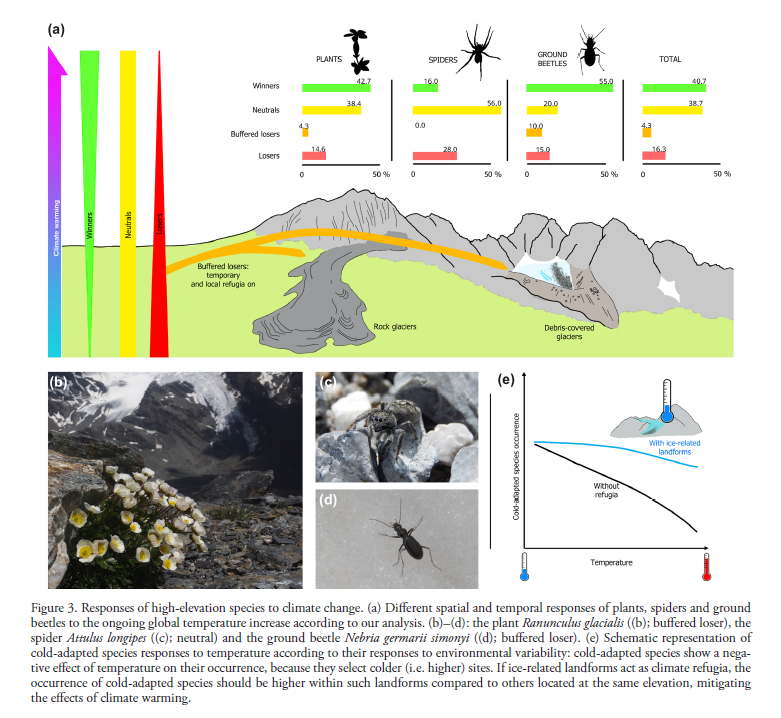
Responses of high-elevation species to climate change. Figure credit: Gobbi, Valle, Brambilla et al., 2026.
A 13-year field study conducted across the Italian Alps found that 21% of 43 species identified as heavily threatened by increasing temperatures have persisted on rock and debris-covered glaciers (Gobbi, Valle, Brambilla, et al., 2026). The impacts on plants and ground beetles, in particular, were found to be buffered by the cold microclimates that persist in rock and debris-covered glaciers (Gobbi, Valle, Brambilla, et al., 2026).
The impact to spiders, on the other hand, was not buffered by this microclimate (Gobbi, Valle, Brambilla, et al., 2026). These and other results can help shape conservation priorities for glacial landforms meeting the demands of the Decade of Action for Cryospheric Sciences (2025–2034) declared by the United Nations General Assembly (2024) (Gobbi, Valle, Rivalta, et al., 2026).
— RELEVANT RRC PUBLICATIONS —
Gobbi, M., Valle, B., Brambilla, M., Tampucci, D., & Caccianiga, M. (2026). Global threats, local opportunities: Ice-related landforms provide refugia for high-elevation plants and arthropods. Ecography, e08695. https://doi.org/10.1002/ecog.08695
Gobbi, M., Valle, B., Rivalta, V. T., Caccianiga, M., Lencioni, V., Ambrosini, R., & Ficetola, G. F. (2026). The EU’s cryosphere biodiversity blind spot. Science, 392, 365-366. https://doi.org/10.1126/science.aeg3085
Morelli, T. L., Mozelewski, T., Cavalieri, C. N., Caven, A. J., Dreiss, L. M., Hovel, R. A., Hua, M., Jennings, M. K., John, A., Kehm, G., Keppel, G., Krawchuk, M. A., Langdon, S. F., Lawler, J. J., Lyon, L. M., Meigs, G. W., Mora-Gonzalez, M., Nadeau, C. P., Słowińska, S., … Stralberg, D. (2026). Conserving climate-change refugia: Insights from research and practice. Conservation Science and Practice, 8(1), e70160. https://doi.org/10.1111/csp2.70160
Simoncini, A., Cantera, I., Giachello, S., Valle, B., Gobbi, M., Fontaneto, D., Zawierucha, K., Laniecki, R., Coulson, S. J., Lencioni, V., Cauvy-Fraunié, S., Ordóñez, A. M., Losapio, G., Takeuchi, N., Liu, Q., Shain, D. H., Fair, H., Janko, K., Devetter, M., . . . Ficetola, G. F. (2026). The global diversity and decline of glacier animals. Proceedings of the National Academy of Sciences, 123(25), e2514455123. https://doi.org/10.1073/pnas.2514455123
Valle, B., Barbon, G., Cucini, C., Nardi, F., Ambrosini, R., Boschi, S., Buda, J., Ficetola, G. F., Frati, F., Kováč, Ľ., Marta, S., Scotti, R., Toscano Rivalta, V., Zimmer, A., Gobbi, M., & Caccianiga, M. (2025). The Unexplored Biodiversity of ‘Glacier Fleas’ (Hexapoda: Collembola): Taxonomy, Distribution and Ecology in the European Alps and Apennines. Journal of Zoological Systematics and Evolutionary Research, 2025(1), 1616350. https://doi.org/10.1155/jzs/1616350
Valle, B., Ligi, O., Invernizzi, A., Fiaschi, T., Gobbi, M., & Caccianiga, M. (2024). Moss flora of two Alpine glacial and periglacial sites on crystalline and carbonatic bedrock. Natural History Sciences, 12(1), 13–20. https://doi.org/10.4081/nhs.2024.809
Valle, B., di Musciano, M., Gobbi, M., Bonelli, M., Colonnelli, E., Gardini, G., Migliorini, M., Pantini, P., Zanetti, A., Berrilli, E., Frattaroli, A. R., Fugazza, D., Invernizzi, A., & Caccianiga, M. (2022). Biodiversity and ecology of plants and arthropods on the last preserved glacier of the Apennines mountain chain (Italy). The Holocene, 32(8), 853–865. https://doi.org/10.1177/09596836221096292
Gobbi, M., & Lencioni, V. (2021). Glacial Biodiversity: Lessons from Ground-dwelling and Aquatic Insects. In Glaciers and the Polar Environment. IntechOpen. https://doi.org/10.5772/intechopen.92826
Gobbi, M. (2020). Global warning: Challenges, threats and opportunities for ground beetles (Coleoptera: Carabidae) in high altitude habitats. Acta Zoologica Academiae Scientiarum Hungaricae, 66(Suppl.), 5–20. https://doi.org/10.17109/AZH.66.Suppl.5.2020
Valle, B., Ambrosini, R., Caccianiga, M., & Gobbi, M. (2020). Ecology of the cold-adapted species Nebria germari (Coleoptera: Carabidae): the role of supraglacial stony debris as refugium during the current interglacial period. Acta Zoologica Academiae Scientiarum Hungaricae, 66(Suppl.), 199–220. https://doi.org/10.17109/AZH.66.Suppl.199.2020
Gobbi, M., Ballarin, F., Brambilla, M., Compostella, C., Isaia, M., Losapio, G., Maffioletti, C., Seppi, R., Tampucci, D. and Caccianiga, M. (2017), Life in harsh environments: carabid and spider trait types and functional diversity on a debris-covered glacier and along its foreland. Ecological Entomology, 42: 838-848. https://doi.org/10.1111/een.12456
Tampucci, D., Azzoni, R. S., Boracchi, P., Citterio, C., Compostella, C., Diolaiuti, G., Isaia, M., Marano, G., Smiraglia, C., Gobbi, M., & Caccianiga, M. (2017). Debris-covered glaciers as habitat for plant and arthropod species: Environmental framework and colonization patterns. Ecological Complexity, 32, 42–52. https://doi.org/10.1016/j.ecocom.2017.09.004
Tampucci, D., Gobbi, M., Marano, G., Boracchi, P., Boffa, G., Ballarin, F., Pantini, P., Seppi, R., Compostella, C., & Caccianiga, M. (2017). Ecology of active rock glaciers and surrounding landforms: Climate, soil, plants and arthropods. Boreas, Vol. 46, pp. 185–198. 10.1111/bor.12219
Tampucci, D., Citterio, C., Gobbi, M., & Caccianiga, M. (2016). Vegetation outlines of a debris-covered glacier descending below the treeline. Plant Sociology, (53 (1)), 45–54. https://doi.org/10.7338/pls2016531/03
Gobbi, M., Ballarin, F., Compostella, C., Lencioni, V., Seppi, R., Tampucci, D., & Caccianiga, M. (2014) Physical and biological features of an active rock glacier in the Italian Alps. The Holocene, 24(11), 1624-1631. https://doi.org/10.1177/0959683614544050
Gobbi, M., Isaia, M., & De Bernardi, F. (2011). Arthropod colonisation of a debris-covered glacier. The Holocene, 21(2), 343–349. https://doi.org/10.1177/0959683610374885